
Requiem For Another Hellsite

There’s an old joke that circulates among developers, and like most of our jokes, it’s funny because it’s true:
Hobbyist: “I’ll just copy-and-paste from Stack Overflow.”
Junior Developer: “I’ll examine the problem, code and test a solution.”
Senior Developer: “I’ll build a solution compatible with our enterprise’s coding idioms, project architecture, business priorities, and industry best practices.”
Distinguished Engineer: “I’ll just copy-and-paste from where I put it on Stack Overflow.”
The circle of life in software development. What goes around comes around. Your mis-spent youth become part of your legacy.
Except now, the legacy is being sold for parts.
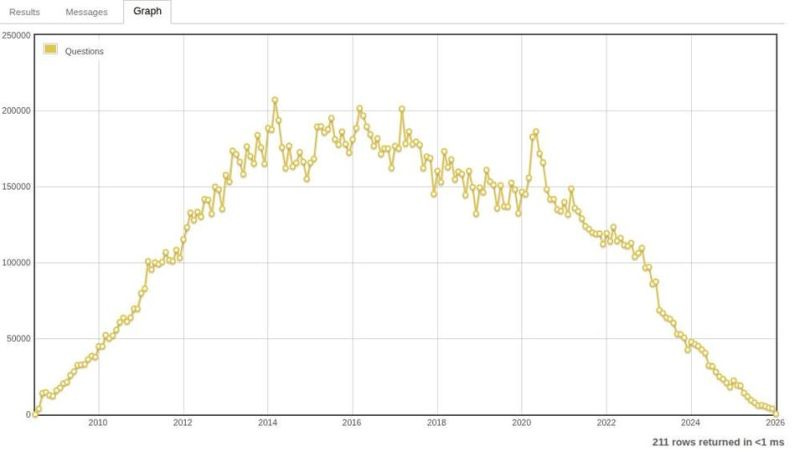
This chart has been making the rounds recently, pulled from Stack Overflow’s public data explorer. Two hundred and eleven months of question volume, rendered in a single depressing arc. The entire history of the site is burned into it’s shape: a startup hockey stick from 2008 to 2014, a plateau through the late teens, drifting downward for a while, and then—starting around 2022—a collapse so steep it looks like one of those graphs on high-school physics quizzes of a penny being dropped from the Empire State Building onto someone’s head.
By 2026, monthly question volume has returned almost exactly to where it was in 2009. The community that once processed a quarter-million questions per month now struggles to maintain five digits. This isn’t decline; it’s disintegration.
I’m writing this more in sorrow than in anger, which surprises even me. Stack Overflow and I had a complicated relationship.
The Good Years
I was an active contributor to Stack Overflow during a period of transcendently boring under-employment from roughly 2010 to 2013, specializing in Scala and functional programming questions. This was the golden age, if you squint. The site was still novel enough that helping strangers felt like participating in something important—a public utility for programmers, a Library of Alexandria where the books answered back.
I was even anointed as a moderator for about two weeks, which sounds more impressive than it was. They changed the karma requirements shortly after, and my brief, illustrious reign ended not with a bang but with an analytics recalculation. Still, I carry that experience like veterans carry old unit patches: meaningless to anyone else, oddly significant to me.
The joke at the top? I lived it. By 2012, I had answered enough questions about monads and type inference that I regularly found myself googling problems only to land on my own answers. The circle closed. The snake ate its tail. I became both the confused developer seeking wisdom and the confident developer dispensing it, separated only by the merciful fog of time.
The First Blow: Self-Inflicted
Stack Overflow’s decline didn’t start with AI. It started with Stack Overflow.
The moderation culture curdled somewhere around 2015, transforming from “quality control” into something more like “quality theater.” Questions were closed with the speed and enthusiasm of a bureaucrat discovering a new form to stamp. Duplicate detection became a blood sport. New users faced a gauntlet of pedantry that would have made a medieval guild blush.
The site optimized for a certain type of contributor: someone with enough reputation to weather the hazing, enough time to parse the ever-expanding rulebook, and enough detachment to not take it personally when their genuine question was marked as a duplicate of something asked in 2011 about a framework that no longer exists.
This was death by a thousand paper cuts, each one inflicted with the best of intentions. The moderators weren’t wrong that quality mattered. They were wrong about what “quality” meant to a community trying to survive. Site usage dropped by about a 25% over four years.
This isn’t a new problem. So far no one has really cracked the “moderate a planet-scale social media site so that it doesn’t turn into a vicious slum” problem. Stack Overflow’s fall was particularly blatant and sad as these things go, but still basically inevitable, the root cause analysis just another variation of “some people are bastards”.
The Second Blow: The Chatbots Arrive
There was a brief resurgence in the site during the pandemic, but then ChatGPT arrived in late 2022, and suddenly everyone could have their own personal Stack Overflow contributor available 24/7, infinitely patient, incapable of being offended when you asked a question that had been asked before.
Look at that chart. The inflection point is unmistakable. The plateau that had held since 2016 simply... broke. Question volume dropped by nearly half in two years.
This wasn’t competition in the traditional sense. Stack Overflow didn’t lose users to a better Q&A site. It lost users to a fundamentally different paradigm—one where you didn’t need to carefully compose your question, worry about whether it met community standards, or wait for an answer that might never come. You just asked, a strange angel answered. The answer might not be perfectly correct and might even be confidently wrong on occasion, but it’s not like the wisdom of crowds was immune to that either.
The irony is acute. Stack Overflow’s moderation policies had trained a generation of developers that asking questions was fraught, embarrassing, potentially punishing, and answering them was not much better. ChatGPT arrived offering unconditional acceptance. The choice was obvious.
The Coup de Grâce: Agentic Coding
But even ChatGPT was a transitional form. What’s killing Stack Overflow now isn’t chatbots—it’s the agentic coding tools that have proliferated through 2024 and 2025.
When your IDE contains an AI that can read your codebase, understand your error messages, and propose fixes in context, the very concept of “asking a question” becomes quaint. You don’t ask questions anymore. You describe intentions. You review proposals. You iterate.
The junior developer copying from Stack Overflow and the senior developer crafting bespoke solutions have both been replaced by a new workflow: describe what you want, watch the agent attempt it, correct course as needed. On those occasions where you actually need to learn something, you might very well request anything from a quick answer to a fully ramified learning journey, but those cases are comparatively rare. The place where knowledge lies isn’t in your head or on a website—it’s in the loop between you and an increasingly capable machine.
Stack Overflow was a solution to a problem that no longer exists in its original form. The old problem was: “I have a question and I need an answer from someone who knows more than me.” The new problem is: “I have an intention and I need a collaborator who can help me realize it.” These are not the same.
The Grief Is Real
I’m genuinely sad about this, which feels silly to admit. Stack Overflow was frequently infuriating. It embodied some of the worst tendencies of programmer culture: credentialism, pedantry, a fetish for rules over judgment. By the end, it was a playground for wannabe HR ladies and the sort of yutz at a conference who says “Not so much a question as a comment…”
But it was also ours. It was proof that programmers could build something collectively, that knowledge could be accumulated and shared, that the answer to “how do I parse JSON in Python” shouldn’t require reinvention from first principles every time some poor soul encountered it.
The knowledge hasn’t disappeared—much of it was licensed by AI builders and used as feedstock for the very models that are now making the site obsolete. In that sense, Stack Overflow didn’t die; it had a brush with transcendence, becoming an early instance of godshatter. Its corpus became training data. Its answers became weights. The Library of Alexandria burned, and the ashes were used to print new books.
That’s not a comforting metaphor. It’s the metaphor we have.
This post was constructed with the able assistance of Claude Opus 4.5, some tiny portion of whose capabilities come from a post about the Try monad I wrote in 2011.
Rhymes with history to have the conqueror help draft the obituary. Vae victis
It was definitely a love / hate relationship, full of drama (and trauma) of all kinds. Your "Coup de Grâce" section may have negated this question entirely, but, do you think it could have recovered? Instead of being everyone else's ashes-to-books, they could have formed their own "ashes into clay" which usually creates net-new outcomes.